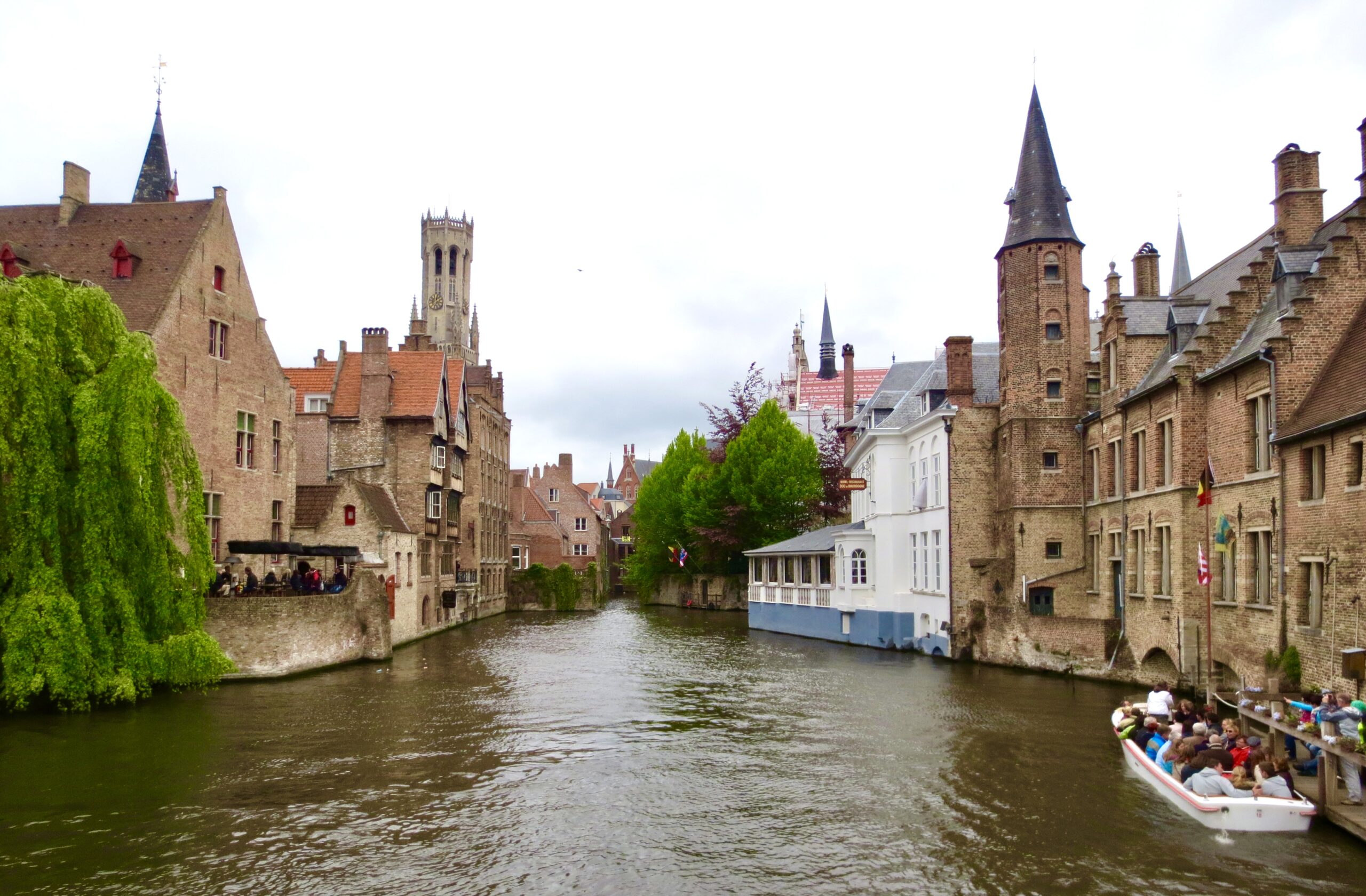
A day of walking the canal town in photos
From the former ramparts and moat of De Vesten into the historic center.
A full day spent walking Bruges—following cobblestone streets along the canals, using rows of brick houses and distant towers as landmarks.
The highlights are the Belfry rising over the city center and the soaring spire of the Church of Our Lady (Onze-Lieve-Vrouwekerk). At Burg Square, the Gothic City Hall radiates a weight and grandeur that makes you feel the deep layers of Bruges’ history.
Bruges is undeniably a tourist destination, yet it only takes one turn into a side alley for the city to become surprisingly quiet. The flow of water, the clip-clop of horse hooves, and the distant sound of bells—this “luxury of few sounds” is, to me, the true charm of Bruges.
Morning begins at the water gate

In the morning light, trees reflect on a canal lined with rows of greenery, and the water gently shimmers.
We had admittedly drunk a bit too much the day before, but this day was for sightseeing in Bruges and Ghent. From Brussels, it’s about an hour by train to Bruges.
This was my second time visiting the “Venice of the North,” and yet simply standing by the canal makes me feel refreshed every time—as if my mind is being rinsed clean.
I’ve heard that Bruges’ old town is encircled by about 7 km of green belt known as De Vesten. The former city walls were landscaped into a green promenade in the 19th century, creating a park-like corridor that connects windmills and old city gates—knowing that makes walking there even more enjoyable.
Wide cobblestone streets—walking with towers in the distance

In Bruges, no matter where you walk, a tower suddenly appears in your line of sight. If you simply walk toward the towers, you naturally end up around the Belfry at Markt Square or near the Church of Our Lady, which makes it pleasantly hard to get lost.

Cobblestones aren’t exactly easy on the feet, but I love how the sound of footsteps seems to belong to the city. And each time you cross a small bridge over the canal, the same scenery shifts slightly—changing expression little by little. That, too, feels very Bruges.
The Bruges cityscape
At the heart of the city, the Belfry houses a carillon of 47 bells and is listed as a UNESCO World Heritage site as part of the Belfries of Belgium and France. If you’re okay with heights, the view from above—reddish-brown rooftops and the curves of the canals—is truly beautiful.
The spire of the Church of Our Lady (Onze-Lieve-Vrouwekerk) is another defining presence in Bruges’ skyline. Against the brick-built city, the spire alone stretches cleanly into the sky, and the feeling of having wandered into a medieval town becomes even stronger.


Summary
Because this was my second visit to Bruges, I ended up keeping things simple this time—just a quick round of sightseeing and lots of photos. I watched the Belfry for a while at Markt Square, wandered along the canals, and somehow that was already enough.
Maybe it was also the rebound effect from eating, drinking, and playing hard in Brussels—on this morning, simply walking while listening to the sound of water felt completely sufficient. A city that can leave you feeling full without “doing” anything is rare.
If the weather is good, biking around the city also seems like a great idea. And if you ride a little farther out, you can enjoy windmills and more waterside scenery—so if you’re planning to spend a full day here, renting a bicycle is highly recommended.
After this, we head to our next destination: Ghent.
Bruges is at its best in the quiet from morning to midday. If you arrive early, it’s much easier to take canal-side photos without crowds.


コメント