
What it felt like to watch the All Blacks perform the Haka at the “House of Pain” — from the stands
The stadium fell silent.
Then 15 men began to stomp, chant, and stare down the opposition with an intensity I’d never seen before.
I was sitting in the stands at Carisbrook — a stadium so feared by visiting teams it earned the nickname “The House of Pain.” And even I, just a spectator in the crowd, felt a chill run down my spine.
This is the side of Dunedin that doesn’t make it into most travel guides.
The City’s Pride: Blue & Gold

I lived in Dunedin around 2010, and one of the first things I noticed was how seriously this city takes its rugby.
On weekends when there’s a match, the entire city transforms. Dunedin is suddenly washed in blue and gold — the colors of the Otago region, worn proudly by supporters of the Highlanders and the Otago representative side.
Supermarket staff, bus drivers, people walking their dogs — everyone seems to be wearing the colors. That sense of collective pride and unity is something I’ve rarely felt anywhere else. It’s one of Dunedin’s greatest charms.

The Legendary Stadium: Carisbrook — “The House of Pain”
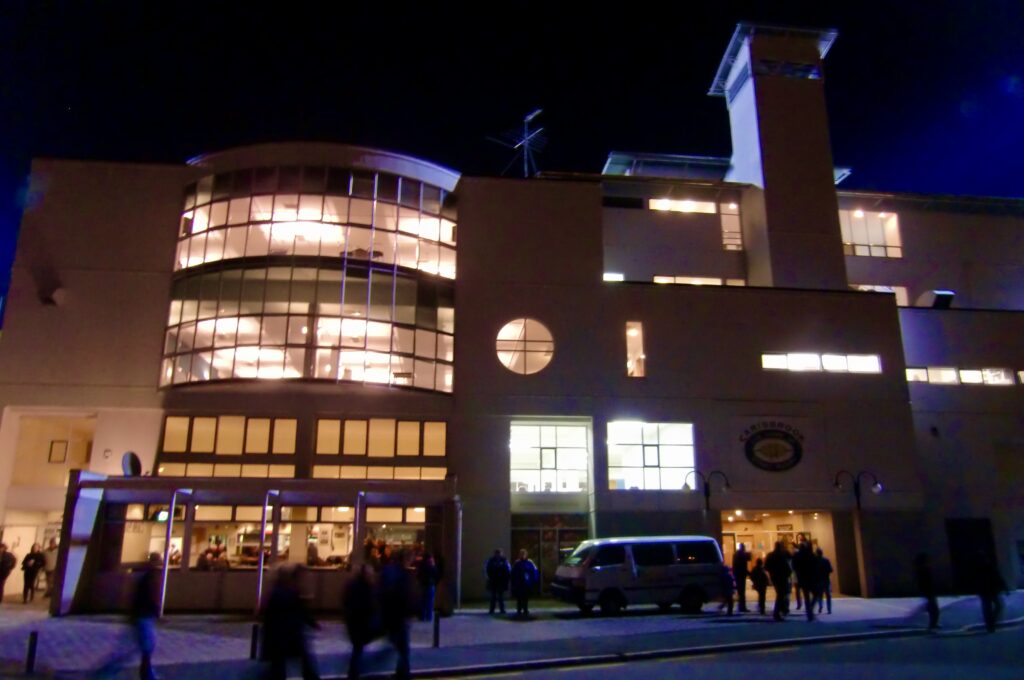
Note: Carisbrook was demolished in 2012 and no longer exists. It has since been replaced by Forsyth Barr Stadium, an indoor venue in central Dunedin.
Before it was torn down, Dunedin had a stadium unlike any other: Carisbrook. Built in 1883 and used for over a century, it became one of New Zealand’s most iconic rugby venues — and one of the most feared.
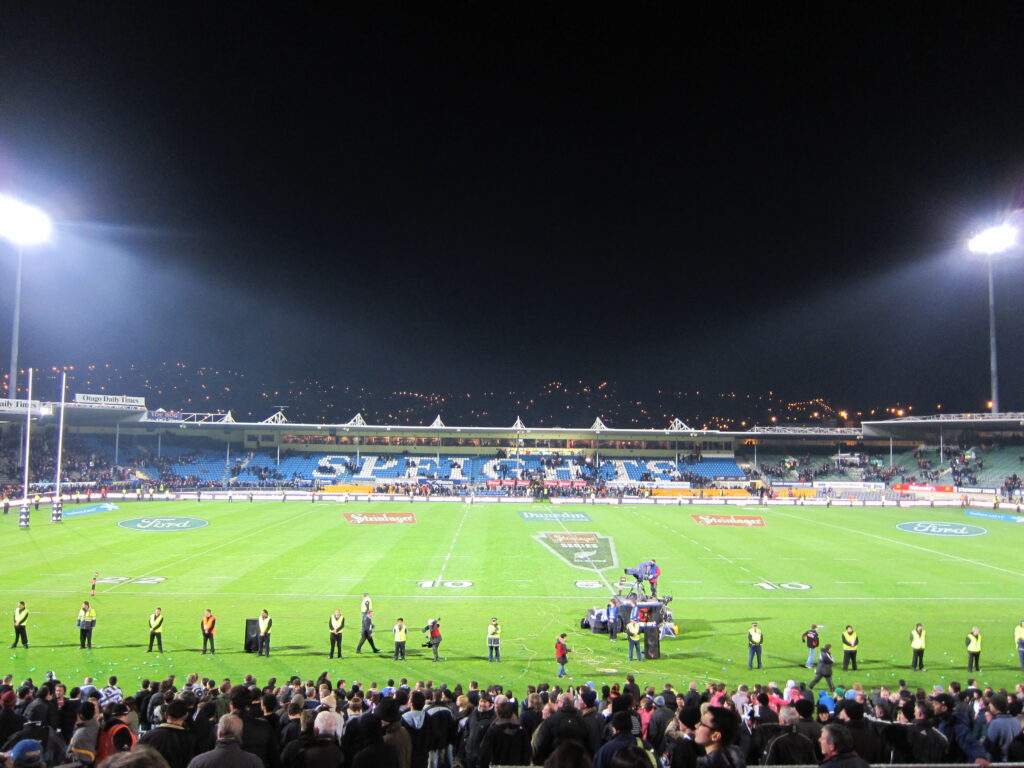
For visiting teams, the “pain” came from three things.
First, the cold. The wind that cut through the open stands felt like it was blowing straight up from Antarctica. No amount of layering seemed to help.
Second, the noise. The crowd was deafening — the kind of roar that seems to physically press against you.
Third, the proximity. The pitch felt almost within arm’s reach of the spectators. There was nowhere to hide — not for the players, and not for the crowd either.
For opponents, Carisbrook wasn’t just a difficult place to play. It was a place where defeat felt inevitable before the whistle even blew.
The All Blacks and a Soul-Shaking Haka at a Rugby Shrine
The All Blacks and a Haka That Stopped Time
By sheer luck, I managed to get tickets to an All Blacks test match at Carisbrook.
The opposing team walked out. The crowd noise died down into an uncanny silence — the kind that feels almost more intense than the roar that preceded it.
And then it began.
What I witnessed that day was “Kapa O Pango” — not the more widely known “Kā Mate,” but a Haka composed specifically for the All Blacks in 2005. It’s darker, more intense, and in my opinion, even more powerful.
Watching it on television doesn’t prepare you for the real thing. The stomping reverberates through the ground beneath your feet. The voices fill the entire stadium. And the eye contact — the way the players stare down their opponents — carries a genuine ferocity that makes the hair on your arms stand up.
At Carisbrook, in that stadium, it wasn’t just the opposing team who felt it. Every single person in those stands felt it too — a strange mixture of fear and awe that I still can’t fully put into words.
The match ended in a dominant All Blacks win. The whole city turned into a sea of black, and the celebrations in the pubs continued well into the night.

Forsyth Barr Stadium: Carisbrook’s Successor
For those visiting Dunedin today, Carisbrook is gone — but rugby very much lives on.
Forsyth Barr Stadium, which opened in 2011, is now home to the Highlanders. It’s a fully enclosed, roofed stadium in the heart of the city — a very different atmosphere from the raw, open-air intensity of Carisbrook, but worth a visit if there’s a match on during your stay.
Practical Info:
- Address: 130 Anzac Avenue, Dunedin (walking distance from the city center)
- Home to the Highlanders (Super Rugby)
- Check the Highlanders website for match schedules: highlanders.co.nz ※Check current schedule
Wrap-Up: A City Where Stillness and Passion Coexist
Beautiful Victorian architecture. Dramatic coastline. A thriving university culture. And rugby fans who wear their colors like a second skin.
Living in Dunedin gave me all of this at once — and 15 years later, the memory of standing in those blue and gold stands, shouting myself hoarse, still feels like one of the most vivid experiences of my life.
If you visit Dunedin and there’s a match on — go. Don’t think about it. Just go.
Hiro | I’ve lived in Japan, New Zealand, Europe, and North America — and I write about the places I called home. Travel blog → live-travel-log.com/en


コメント