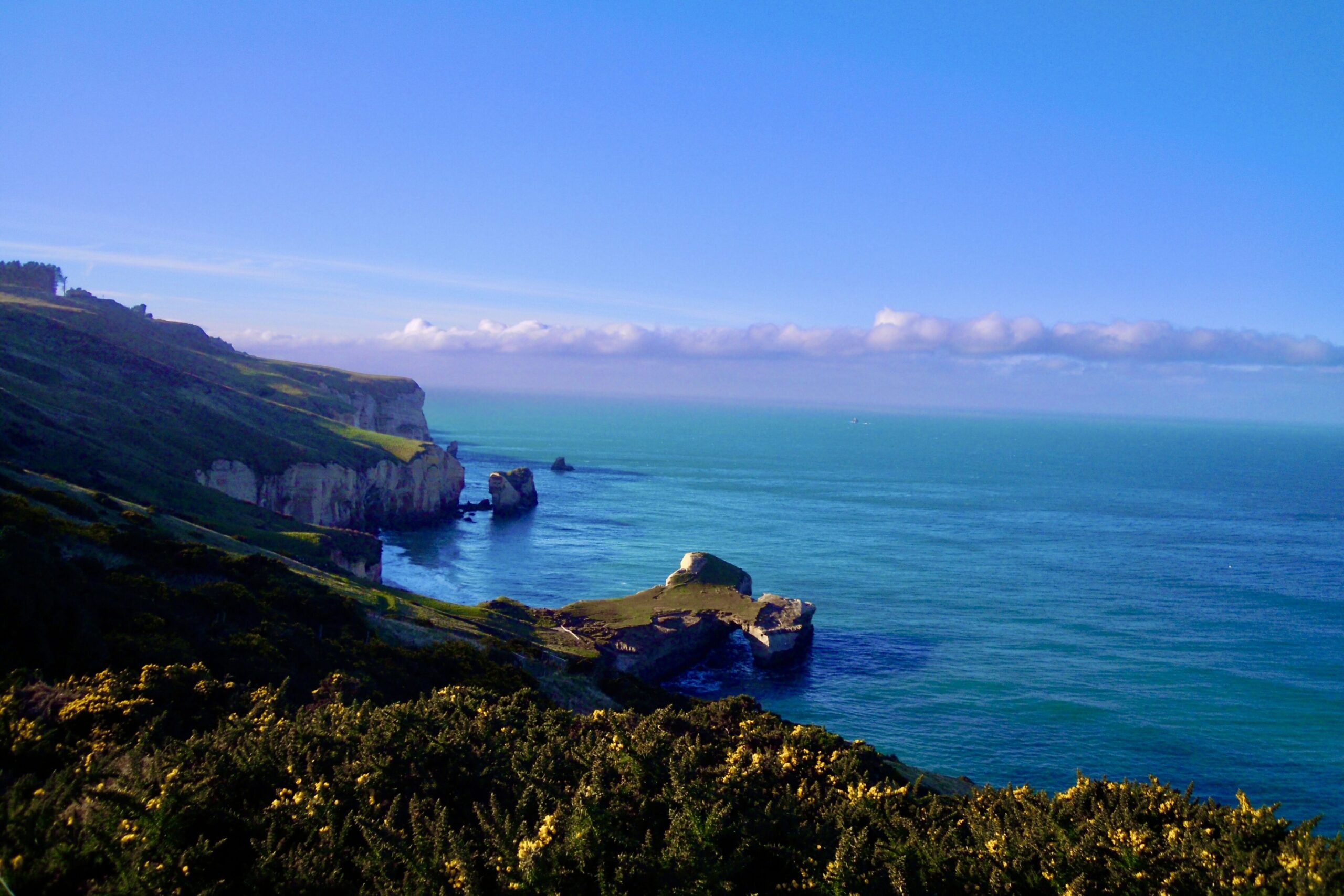
A local’s guide to the wild side of Dunedin — just 20 minutes from the city center
Most people know Dunedin for its stunning architecture and student energy. But just a 20–30 minute drive from those Scottish-style stone buildings, the scenery changes completely.
Suddenly, you’re standing on the edge of dramatic cliffs, watching endangered penguins waddle ashore at dusk, or noticing a wild fur seal napping on the rocks behind you.
This is the other side of Dunedin — and in some ways, it’s even better.
- Dramatic Cliffs and a Secret Beach: Tunnel Beach
- A Rare Nesting Site: Royal Albatross at Taiaroa Head
- An Endangered Species: Yellow-Eyed Penguins (Hoiho)
- Napping on the Rocks: Fur Seals and Sea Lions
- Bonus: Cafés and Surfing at St Clair Beach
- Getting to the Otago Peninsula
- Wrap-Up: Dunedin, a City That Lives Alongside Nature
Dramatic Cliffs and a Secret Beach: Tunnel Beach

If you only have time for one thing outside the Dunedin city center, make it Tunnel Beach.
From the car park, you follow a marked trail that runs alongside private farmland, descending steeply through open pasture. As you get lower, enormous sea-carved rock formations begin to appear — dramatic columns and arches jutting out into the ocean.

Then you reach the tunnel itself: a hand-carved passageway cut through solid rock, said to have been created in the 1870s by a local politician so his family could access the beach below. Walking through the dim tunnel and emerging onto the secluded beach below feels genuinely magical.

The beach is surrounded on all sides by towering cliffs and rock walls. It easily ranks in my personal top three beaches of all time. The climb back up will leave you out of breath — but the view is completely worth it.

Practical Info:
Address: Tunnel Beach Road, Blackhead, Dunedin
Getting there: About 20 minutes by car from the city center. Limited parking at the trailhead
The trail is approx. 1.5 km return — allow 1–1.5 hours
The path can be slippery when wet — wear sturdy shoes
Free to visit
A Rare Nesting Site: Royal Albatross at Taiaroa Head
At the very tip of the Otago Peninsula sits Taiaroa Head — one of the only places in the world where royal albatrosses nest on a mainland. These are massive birds with wingspans of up to 3 meters, and watching them soar above the cliffs is unforgettable.
The Royal Albatross Centre runs guided tours that give you the best chance of seeing the birds up close. Unfortunately, I didn’t manage to visit during my time in Dunedin, but it’s at the top of my list for next time.
Practical Info:
Website: albatross.org.nz ※Check current tour times and prices
Address: Taiaroa Head, Otago Peninsula (approx. 40 minutes from Dunedin city center)
Booking in advance is strongly recommended — tours sell out, especially in summer
Best time to visit: November to February (chick season)
An Endangered Species: Yellow-Eyed Penguins (Hoiho)
When people think of New Zealand wildlife, penguins often come to mind — but the yellow-eyed penguins you can see around Dunedin are something special. Known in Māori as hoiho (“noise shouter”), they’re one of the rarest penguin species in the world.
They’re also extremely shy. The trick is to arrive at a beach on the Otago Peninsula around dusk, find a quiet spot behind the rocks, and wait. If you’re patient and silent, you’ll be rewarded with the sight of penguins emerging from the surf and waddling back to their nests.
It’s one of my favorite memories from living in Dunedin — genuinely soothing to watch.

Practical Info:
Free to visit the beaches independently
Best viewing spots: Sandfly Bay and Bushy Beach on the Otago Peninsula, and Aramoana
Best time: Dusk, when penguins return from the sea (timing varies by season)
Keep at least 10 meters distance — do not use flash photography
Napping on the Rocks: Fur Seals and Sea Lions

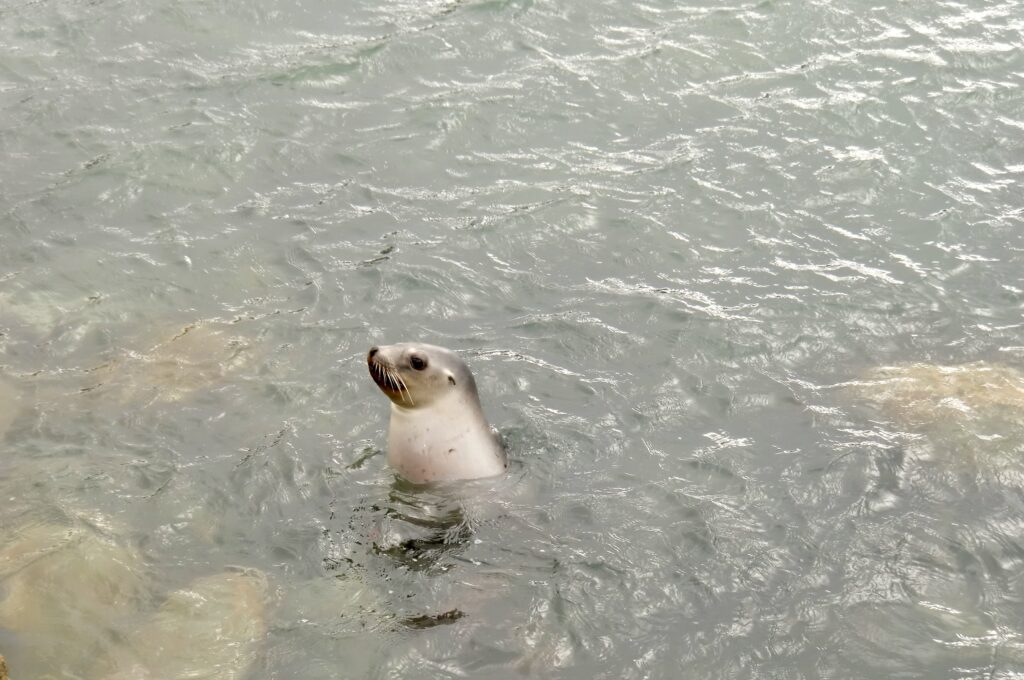
While I was quietly watching the penguins one afternoon, I turned around to find a wild New Zealand fur seal sunbathing on the rocks just a few meters behind me.
That’s what makes wildlife watching around Dunedin so special — there are no fences, no barriers. Just animals living their lives, and you as a quiet observer.
Sea lions can also be spotted on certain beaches along the Otago Peninsula. Up close, they’re much larger than you’d expect — almost intimidating. They have real presence.
Practical Info:
Never approach or feed wildlife
Fur seals: Commonly seen at Lovers Leap and around the Otago Peninsula coastline, and in Aramoana
Keep a safe distance (at least 20 meters for sea lions) — they can move surprisingly fast
Bonus: Cafés and Surfing at St Clair Beach
On your way back from the Otago Peninsula, or any time you want a relaxed end to the day, St Clair Beach is worth a stop. It’s about a 10-minute drive from the city center.
Think of it as Dunedin’s laid-back coastal neighborhood — a stretch of beachfront lined with stylish cafés, bars, and an outdoor heated saltwater pool. On good days, you’ll see surfers in the water.
It’s not a dramatic landscape like Tunnel Beach, but it has a great everyday energy — the kind of place where locals go to decompress.


Practical Info:
Several good cafés along the Esplanade — great for coffee or a meal after a day of wildlife watching
Address: Esplanade, St Clair, Dunedin
The St Clair Hot Salt Water Pool is a Dunedin institution — worth a visit ※Check current opening hours
Getting to the Otago Peninsula
A car is by far the easiest option. The main road along the peninsula (Portobello Road) is scenic and well-maintained.
Wrap-Up: Dunedin, a City That Lives Alongside Nature
What made living in Dunedin feel so rich was exactly this: in the morning, you could be studying or wandering the Victorian streets of the city center. By afternoon, you could be watching penguins come ashore on a wild, wind-swept beach.
That combination — history and wilderness, architecture and nature, all within 30 minutes of each other — is what makes Dunedin unlike anywhere else I’ve lived.
If you’re visiting New Zealand’s South Island, don’t just pass through Dunedin. Give it at least two days. You’ll need one for the city, and one for the wild side.
Hiro | I’ve lived in Japan, New Zealand, Europe, and North America — and I write about the places I called home. Travel blog → live-travel-log.com/en


コメント