This trip takes us to Hamburg, Germany’s second-largest city. From Berlin, it’s about 2.5 hours by train, or roughly 3 hours by bus.
The moment you step out of the station, you feel it: the city’s overwhelming scale and constant energy. Known as “Tor zur Welt” (Gateway to the World), Germany’s largest port city carries two faces at once—the rugged, industrial spirit of a harbor town and the polished elegance of a sophisticated European city.
- The Harbor’s Icon: Sankt Pauli Landungsbrücken
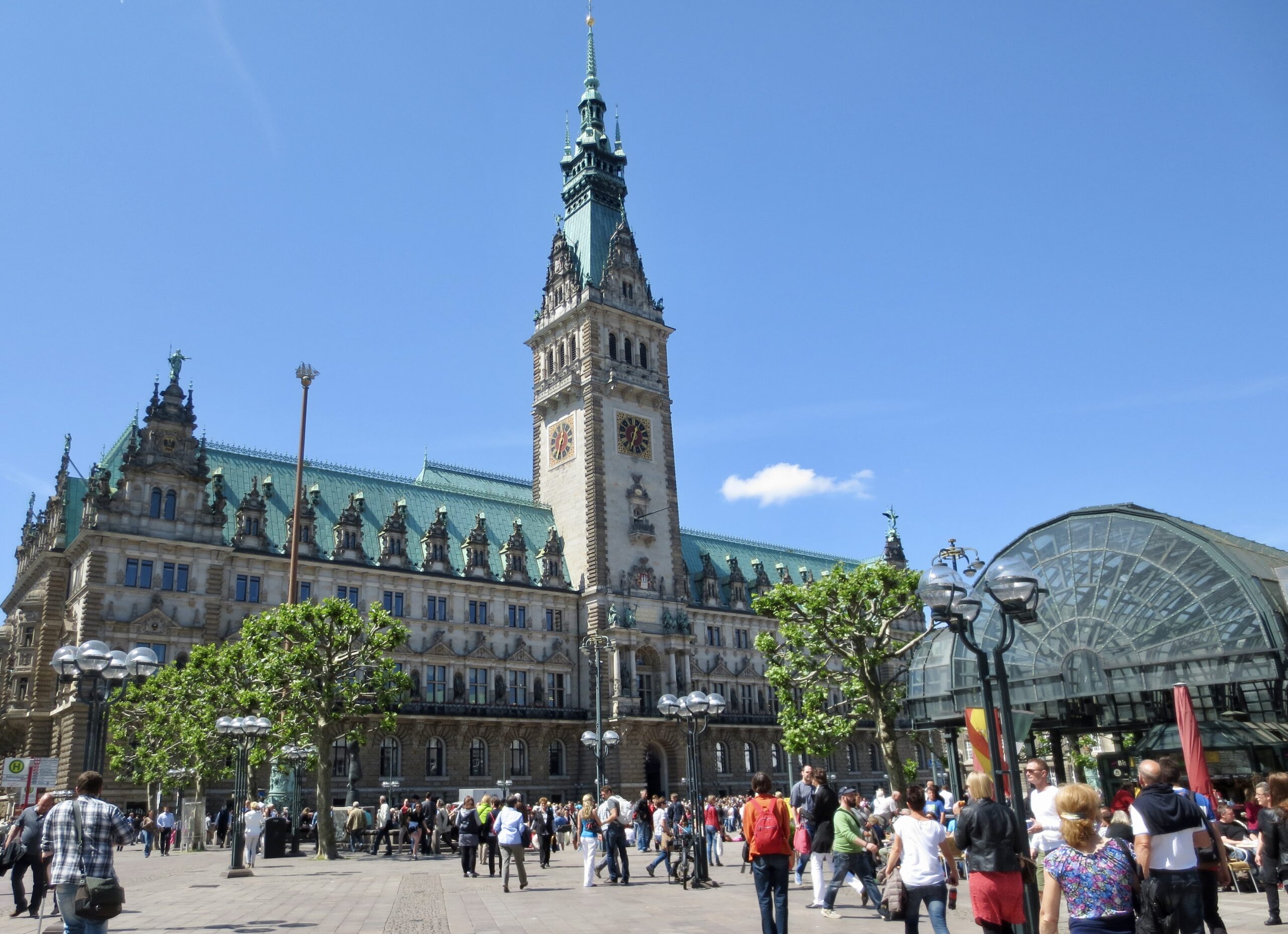
- A Monument to Wealth: Hamburg City Hall (Hamburger Rathaus)
- The Elegance of a “City of Water”: Arcades, Canals, and the Alster
- Giant Cranes and Paddle Steamers — The Chaos Is the Best Part
- Sunday Morning Madness: Fischmarkt & Fischauktionshalle
- A City with Two Faces
The Harbor’s Icon: Sankt Pauli Landungsbrücken

My first stop was Landungsbrücken, the famous waterfront piers along the Elbe.
With the silhouette of the clock tower glowing in backlight, ships come and go—some heading out into the world, others returning from across the seas. The salty air, the cries of seagulls, and the low rumble of ferry engines all blend together into one unmistakable feeling: I’m in Hamburg.

Walking along the harbor, you discover that Hamburg’s charm goes far beyond the UNESCO-listed warehouse district of Speicherstadt. Around Große Elbstraße, you’ll find modern spaces created by renovating old brick factories and warehouses. Near Stilwerk, where design shops gather, you can sense Hamburg’s aesthetic: don’t tear the old down—keep it and give it a new life.
A Monument to Wealth: Hamburg City Hall (Hamburger Rathaus)

Move from the harbor into the city center and the scenery shifts dramatically.
Suddenly, Hamburg City Hall (Rathaus) appears—its green-patinated roof and richly detailed façade so grand it feels almost like a royal palace.
Historically, Hamburg protected its independence as a “Free and Hanseatic City,” which means it didn’t have a king. This splendid city hall wasn’t built by royalty, but by the power and wealth of citizens—merchants, and the prosperity brought in by the port. In a single building, you can feel just how vast that wealth must have been.
The Elegance of a “City of Water”: Arcades, Canals, and the Alster

Behind the city hall, you’ll find the Alsterarkaden, a beautiful white colonnade. The arches reflected on the water are so graceful they almost bring Italy to mind.

Hamburg is threaded with countless canals, and it’s said the city has even more bridges than Venice or Amsterdam. At the Alster in the city center, you’ll see people sailing yachts—an entirely different world from the harbor’s air of steel and engine oil. Here, time feels refined and leisurely.

Around Neuer Wall, luxury boutiques line the streets, revealing yet another side of Hamburg—one that contrasts sharply with the warehouse district.
Giant Cranes and Paddle Steamers — The Chaos Is the Best Part

Back in the harbor area, that “romance of industry” returns.
In front of you is a striking mix: classic paddle steamers alongside modern, towering cranes. It’s a tourist destination, yes—but also very much an active industrial zone. That messy, layered mix is exactly what makes Hamburg so irresistible.
Sunday Morning Madness: Fischmarkt & Fischauktionshalle

The highlight of the trip came early Sunday morning: Hamburg’s famous Fischmarkt.
It starts at 5 a.m. (or 7 a.m. in winter) and wraps up before noon. Fresh fish is the main attraction, of course, but you’ll also find fruit, flowers, and random little bargains—sold loudly and energetically from the backs of trucks.

Then you step inside the main venue, Fischauktionshalle, and everything changes.
A live band blasts rock music at full volume. People dance—beer in hand—dance, dance, dance. It’s less “breakfast” and more “Saturday night’s party is still going.” Seeing Germans—often stereotyped as serious—living with that much joy and energy so early in the day was honestly invigorating.
A City with Two Faces
The lakeside Alster feels like an “elegant lady,” while the harbor’s raw energy feels like a “rough sailor.” That duality is what makes Hamburg so fascinating.
Next time, I’ll leave the city noise behind and head to a soothing landscape of forests and waterways: Spreewald.


コメント